
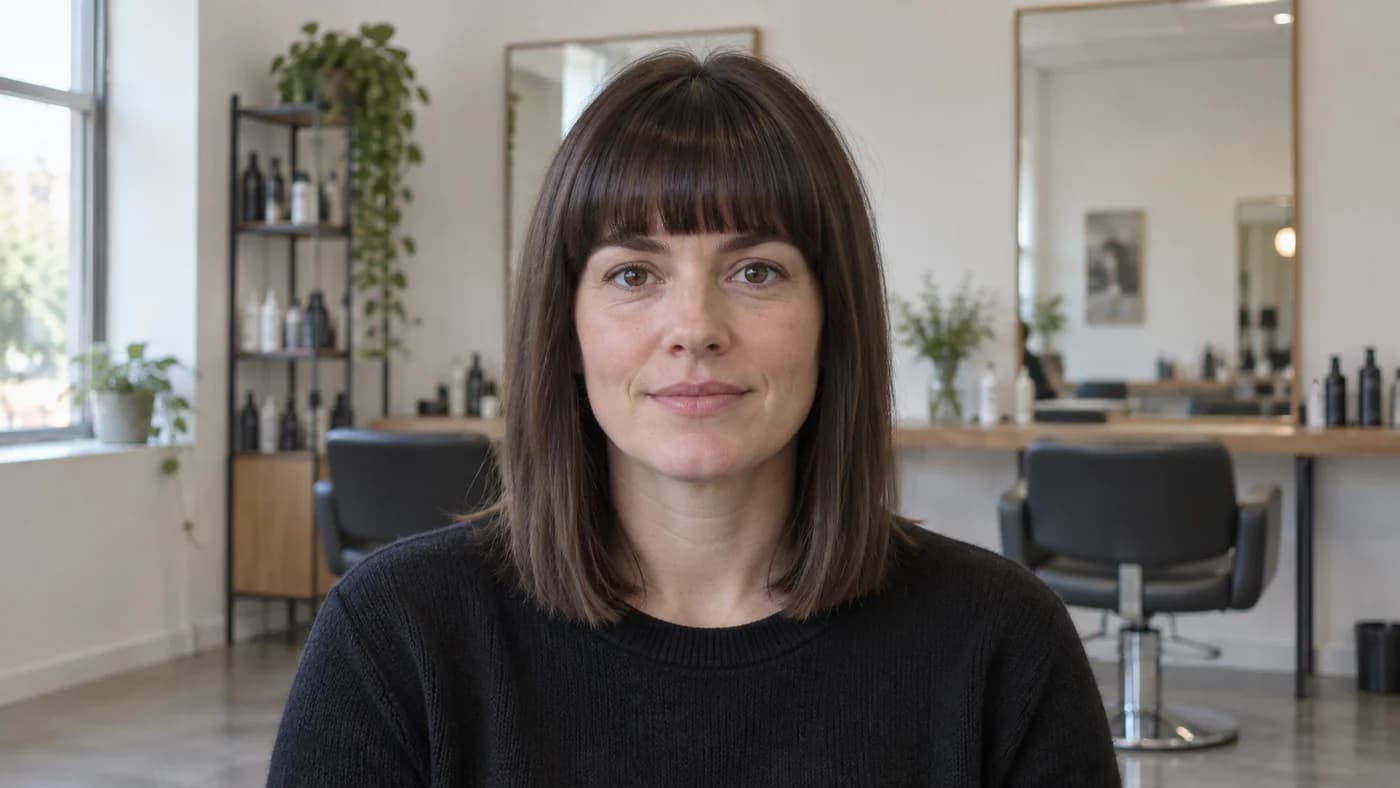
A blunt fringe has a defined front edge rather than a deliberately feathered finish. That edge can be light or dense, straight across or slightly shaped. Before asking for blunt bangs, choose where you want the dry hair to sit around your brows and how much forehead you want covered. Bring a picture showing that position, especially if you wear glasses.
Blunt fringe length: use your brows as a reference
Compare a fringe above the brows with one that touches them. The shorter version reveals more of the forehead; the lower edge can meet your glasses or get into your sightline. Try holding your existing fringe at the proposed position, without pulling it tight, to discuss the outline.
Ask for the final length to be judged dry in the direction you normally wear it. Wave, curl and the amount of tension used during cutting can affect where it settles. A suggested measurement is a starting point, not a promise that every strand will land at the same place.
A clean edge does not require a heavy curtain
Density depends partly on how much hair is brought forward to form the fringe. Taking more hair from farther back can change the weight of the top and the way the sides connect. If your hair is fine or sparse at the front, a thick reference fringe may require hair that is not available.
Show your barber both the edge you like and the coverage you want to keep elsewhere. Ask whether the picture can be achieved without a larger section, artificial density or a perm. You can keep a clear edge while choosing less weight, provided your growth pattern allows it.
Look at proportions without assigning a face-shape rule
The fringe creates a visible horizontal line near the eyes. Notice how that line works with your own brow position and the width of the hair at the sides. A face-shape chart cannot tell you whether you will like that amount of coverage when you turn your head or wear glasses.
Keep the rest of the haircut in the comparison. A fringe on a bob will read differently from the same edge on a long layered cut. Change one major feature at a time in your reference discussion, so you know whether you like the fringe or simply the whole styled photograph.
Ask for a cautious first cut
You could say: “I want a defined fringe edge that sits around my brows when dry. Keep the section light enough for my actual hair, and connect the corners to the sides. Please leave it a little longer for the first dry check. I do not want extra thinning or a new color.”
Mention any natural split or cowlick you usually deal with. The barber can inspect it before taking more length off. A front photo can show the current part, but it cannot establish every growth direction hidden underneath the hair.
Find out what the fringe does on a normal morning
After washing, arrange the fringe before it dries into an unwanted split. If you use a dryer, direct it gently along the fringe while moving the hair across and back toward its resting position. Ask the stylist to show a method that works with your hair, rather than relying on a hot tool you do not want to use.
Keep heavy product away from the front unless it is needed for hold. If the fringe separates or looks oily, adding more product rarely improves the clean line. Without styling, expect your natural wave and part to reappear. Consider a trim when the edge interferes with vision or loses the intended brow position.
A blunt fringe is easier to discuss when the reference includes the dry brow position, the amount of coverage and the styling you will actually do. Confirm those before removing the length.
Quick answers
Are blunt bangs always thick?
No. Blunt refers to the defined edge. The section and available hair determine the density.
Can curly hair have a blunt fringe?
It can, but the dry curl pattern and spring need an in-person check. Do not copy the wet length of a straight-hair reference.
Can an AI preview decide the exact length?
It can help you compare the visible edge. Your stylist should set the actual length after checking your hair dry.